This is a platform and network hub for historical studies
about the Greek Orthodox communities of late Ottoman Istanbul / Constantinople
(c. 1821-1923).
Here you will find links to the latest
scholarship, memoirs, and primary source documents, as well as discussion and
emerging scholarship about the many layers of community involving the Greek
Orthodox of “The City” during the long nineteenth century.
Born in Winston-Salem, North Carolina in 1942, West grew up in the Black middle class of that southern city. His parents were educators, demanded quality work from their kids, and he graduated as valedictorian of his high school. He was on to Howard University in 1960, where he studies to become an engineer. He graduated in 1965, but decided on law school instead and stayed at Howard for that degree, finishing it in 1968. He became the managing editor of the school’s law journal and did very well. I don’t think he was actively involved in the civil rights movement too much, which is much more common than not, even in the 60s.
Instead, this Eagle Scout (and he was one) instead joined the military, which was not a decision taken lightly in 1965. Yeah, he did his law degree and his work in the Army Field Artillery Corps at the same time, though don’t ask me how. He became a JAG, doing additional work at the University of Virginia, and was an Army lawyer from 1969 to 1971. West started practicing in DC law firms after he left the military in 1971 but remained involved in military law and veterans issues. Gerald Ford named him associate deputy attorney general in 1975, which meant this was one fast rising man. The Carter presidency kept him around and he continued to rise in the government. Under Carter, he was General Counsel of the Navy from 1977-79, then Special Assistant to the Secretary and to the Deputy Secretary of Defense for a few months, before being named General Counsel for the Defense Department in 1980. Basically, he was a top lawyer for large swaths of the military in these years.
Reagan wasn’t going to keep any Democrats around, so West went back to the law, joining a big firm in DC. He then became the head of government relations for the defense contractor Northrop.
In 1993, Bill Clinton brought West back into the government, as Secretary of the Army. It wasn’t under the best of circumstances. Clinton had named John Shannon to the role….who then got busted shoplifting women’s clothes from an Army base store. Incredible. So Clinton turned to West. It was a hard job. In fact, writing this post was a great reminder of how many enormous issues there were with the military in these years, some of which had to do with Clinton’s notorious lack of understanding of military issues, some of which were just the reality of trying to work out changes in social policy through the military, and some of which were the military’s own doing.
Clinton pushed the “Don’t Ask, Don’t Tell” policy on gays in the military and just dropped it on West to implement. Not fun. He also pushed very hard to expand the role of women in the military, particularly into combat roles, often fighting with lead generals on this key issue.
West also had to deal with the Clinton-era base reductions. Of course this made sense because we had too many military bases and with the Cold War behind us, we didn’t need so many. But this flew right into the military-industrial complex. Every politician desperately wanted the base in their home protected. Honestly, the major daily impact of the military on the daily lives of Americans is as an enormous government jobs program. So to close a military base, especially given that so many were sited in areas without a lot of other economic activity going on, was a real knife to the heart of a given district. It’s kind of amazing that this even happened and almost impossible to consider happening today.
Said historian Richard Kohn, “He seemed undercut in accomplishing a great deal by the gays controversy, an Army leadership focused on dealing with [Defense Secretary Les Aspin’s] ‘bottom-up review,’ budget cuts, controversies over interventions abroad, and changes in threat planning resulting from the end of the Cold War.”
West became a key figure in the Aberdeen scandal that exposed the horrors of sexual assault in the military. One thing Trump and Hegseth and these assholes don’t understand (or perhaps they quite likely do understand and hate it) is that the military been a key agent of social change going back at least to Truman desegregating it in 1948. So as Clinton liberalized it a bit by trying to ride the fence on gay issues, the growing backlash to sexual harassment and sexual assault in the aftermath of Clarence Thomas’ confirmation to the Supreme Court led to greater complaints about endemic sexual harassment and even sexual assault within the military. There were quite literally thousands of complaints about harassment registered in the early 90s. Then, in 1996, twelve drill instructors at the Aberdeen Proving Ground in Maryland were charged with various sexual crimes. It turned out the male drill instructors at Aberdeen treated women like their personal rape club. Four were convicted and sent to prison. West was so public about the horrors of this that the lawyer for one of the convicted tried to get the judge to issue a gag order against him. West did a ton of work to tighten up sexual assault guidelines across the military. He stated, Sexual abuse is not endemic throughout our Army. Sexual harassment, however, continues to be a problem.” He even went on Face the Nation to state, “I say to the parents of America, you can trust your sons and daughters to us.”
For all of this work, Clinton bumped West to Secretary of Veterans Affairs in 1998. This went less well. He worked pretty hard to expand money for veteran health care, but without much success. The VA was also rife with divisions and internal issues, most of which he didn’t cause, but which he didn’t really improve much either.
West spent his post-Clinton years in think tank and lobbying land, like so many before and after him. He also spent some time as the head of the Joint Center for Political and Economic Studies, a vanilla named organization that focuses on issues specifically of concern for Black Americans. Despite being a pioneer in many ways, this was just about the only time he worked explicitly on racial issues in his long career.
West had a massive heart attack while on a Caribbean cruise in 2018 and died. He was 75 years old.
Togo West is buried on the confiscated lands of the traitor Lee, Arlington National Cemetery, Arlington, Virginia. I like to think about Lee realizing that Black Cabinet members are buried on his property and that everything he did in his life was for evil. One can wish. If you would like this series to visit other members of the Clinton Cabinet, you can donate to cover the required expenses here. Hershel Gober, who replaced West at the VA, is also in Arlington and Warren Christopher is in Hollywood. Previous posts in this series are archived here and here.
"Togo West is buried on the confiscated lands of the traitor Lee, Arlington National Cemetery, Arlington, Virginia. I like to think about Lee realizing that Black Cabinet members are buried on his property and that everything he did in his life was for evil. One can wish."
In anticipation of the Purple Line’s scheduled opening in 2027, Montgomery County officials are looking at places to build sidewalks near the light rail line. But plans to build sidewalks near the future Takoma-Langley station, on University Boulevard in Takoma Park, have been shelved in part because neighbors say they’re afraid of “stranger danger.”
Staff at the Montgomery County Department of Transportation (MCDOT) identified eight residential streets within a half-mile of the station that were missing sidewalks, then sent information about the proposal to over 150 nearby households. Fewer than half replied, but those who did were mostly against it. According to the letter from Robert Gonzales, Sidewalk Section Chief, of the 73 residents who responded, just 12 supported the sidewalks.
“In the remaining 61 comments, residents heavily opposed the installations,” Gonzales wrote, “expressing concerns about loss of available parking, lack of need, financial loss due to tree and landscaping removals, loss of environmental beauty and the ‘natural feel’ of the community, stranger danger, increased crime, littering, and, most of all, the worsening of stormwater flooding and erosion.”
Gonzales added that the county’s budget doesn’t have enough money to install the sidewalks anyway. “Our decision is clear,” he concluded. “None of the proposed sidewalks will be installed.”
“Stranger danger” is a concept dating to the 1960s, when high-profile cases of children being abducted or murdered began appearing in the news. If you grew up in the 1990s like me, you probably remember pictures of missing kids on milk cartons or round-the-clock news coverage about child kidnappings.
In a now-deleted Bluesky post, an agency staffer said they asked residents in Bethesda’s Kenwood neighborhood, where thousands of people go to see cherry blossoms each spring, about building sidewalks. MCDOT decided not to after 50 households–a majority of those who replied, but just 20% of the whole neighborhood–were opposed.
Screenshot of a deleted post from MCDOT’s Bluesky page.
Even in neighborhoods where there’s vocal support for pedestrian improvements, MCDOT is slow to act. The agency rejected a Rockville neighborhood’s request for a stop sign near Wood Middle School after a driver hit one child, and only relented after another child was killed by a school bus. Here in East Silver Spring, my neighbors and I are pushing for stop signs at two intersections where drivers hit me and my dog and an 11-year-old boy this year. Bethesda Today recently covered that effort and was told by Michael Paylor, who’s in charge of traffic engineering and operations at MCDOT, that “sometimes it’s the best interest of the county to do nothing.”
Montgomery County boasts that it’s one of the first places in the United States to adopt Vision Zero, pledging to end all traffic fatalities by 2030. But between January and October 2025, 358 pedestrians were involved in a crash, 12 of whom died. That’s basically the same as four years ago. Giving people more safe places to walk by building more sidewalks, especially near a transit station that many people will walk to, would go a long way in reversing this trend. If this county were serious about safety, it wouldn’t use “stranger danger” as a reason not to build sidewalks.
The Department of Transportation is overseen by County Executive Marc Elrich, who is term-limited and is instead running for County Council. Next year’s Democratic primary on June 23, 2026 will likely decide his successor, who will be responsible for the agency. We’ll be endorsing in the executive and county council races, and asking the candidates if they support building more sidewalks–or making more excuses.
At the mouth of Lake Constance (Bodensee), where the Rhine slips toward Switzerland, a nine-meter courtesan spins in slow defiance. Her name is Imperia, and she’s been turning — quite literally — since 1993.
Sculpted by Peter Lenk, she rotates once every four minutes, balancing two tiny naked men in her hands: one crowned like an emperor, the other wearing a papal tiara. Both look foolish. Both are helpless. And both, in her grasp, symbolize a truth Konstanz has never quite lived down — that power and piety often share the same bed.
The story behind her grin reaches back to the Council of Constance (1414–1418), when Europe’s most powerful clerics and rulers gathered here to end the Great Schism. For four years, the small lakeside city overflowed with popes, princes — and prostitutes. Chroniclers whispered that the “holy” council was shadowed by carnal excess.
Lenk drew inspiration from Balzac’s 1830s story La belle Imperia, in which a courtesan seduces the church’s elite during that very council. When the sculptor unveiled his version, local politicians and priests tried to have it removed. He sidestepped them by placing it on private harbor land, untouchable by city order. Overnight, Imperia began to turn — a concrete act of rebellion.
Today, she is Konstanz’s icon, declared a cultural monument in 2024. Tourists pose beneath her; locals still argue about her. But Imperia endures, her slow rotation a reminder that the sacred and the profane are never far apart — and that sometimes, history itself needs a woman to keep it spinning.
Born in 1937 in Nespelem, Washington, Bernie Reyes was half Sinixt and half Filipino, the latter on his father’s side. He grew up much more with an Native identity than an Asian one, as her father basically lived as her mother wanted. Mostly, he grew up on the Colville Reservation in northeastern Washington, a large piece of land where a lot of tribes were thrown after the genocidal conquest in the late 19th century, most famously the Nez Perce. The Sinixt were another of those tribes and I think his mother had grown up there. They ran a Chinese restaurant for workers building the Grand Coulee Dam, which borders the reservation. They had a Chinese partner. Her mother later her left her husband and married the Chinese guy. The family was very, very poor, often with electricity and food itself was sometimes in question. His older sister Luana, who would make a major impact herself on American life later due to her work with the Indian Health Service, went off to boarding school, but the younger Bernie stayed with his grandparents for the most part and sometimes with his father.
Reyes was a pretty good student and went off reservation to Okanogan High, where he was a very fine trumpet player. Then it was off to the University of Washington. It was had for a Native and Asian kid at a university in the 1950s. He went for a year, dropped out, lived with his mother who was now in Seattle for a bit, and fell into some Native activists who were determined to fish for salmon regardless of what the state had to say about it. After all, they were guaranteed that salmon in treaties signed in the 1850s and if the state and racist Washington whites wanted to challenge them, they’d push back.
In 1957, Reyes enlisted in the Army and served a couple of years. Upon his return to civilian life in 1959, he changed his name to Bernie Whitebear to reflect his Native identity. He got more involved in the fishing rights issues being pushed by people such as Bob Satiacum and Billy Frank, Puyallups ready to be arrested in order to fish for salmon. The 60s became an enormous learning period for Whitebear. Termination, the Eisenhower-era genocidal attempt to eliminate special status for the tribes, forced many Native Americans to the cities, where they lived in great poverty. Whitebear was spending lots of times in Tacoma and Seattle. Indian bars were major gathering places. They were also violent spaces. Whitebear was learning about politics while also beating up other people and getting himself beat up plenty too. He and his Puyallup friends were basically a gang, but that’s to be expected in a poverty situation like this. Then, in 1961, the state of Washington appealed to the Kennedy administration to terminate the Colville Reservation, where Whitebear had grown up. The new administration had far less interest in this than the Republicans had, but it still had to be fought and Whitebear became prominent in defending his people’s land.
Whitebear moved to Seattle in 1961, got a job at Boeing, and became a major Native rights organizer in the city. This was the era of Pan-Indianism, as these different tribes forced into the cities began to realize that they had a lot in common with each other and that old animosities meant less than gathering together to fight white domination of all of them. Whitebear was a major player in this by organizing pow-wows in Seattle. These became such a big deal that by the late 60s, they were touring Europe to fascinated audiences.
Whitebear was also angry at the lack of health care for Native Americans. He and others started medical clinics specifically for Native Americans in Seattle. He was certainly not alone here; the Seattle indigneous community had become quite politicized and organized in the last few years. They started the Seattle Indian Health Board and Whitebear became the executive director. He later passed this on to his sister Luana, who still used the family last name of Reyes. In truth, he was distracted for the year he ran it because he got focused on gaining land for Native Americans in Seattle.
By all accounts, Whitebear was hyper focused on making life better for fellow Native Americans in Washington’s cities. That was his life mission. He was evidently a brilliant guy and someone who was pretty intense and driven, so he was the right person for the job. Land was the ticket. Land would provide a cultural center and an identity that would force white Seattle to wake up to the Native communities in their city, which was really quite large both because of the sizable indigenous population that had always lived there and because people such as Whitebear and so many others had moved there for economic opportunity or because they were shoved there during Termination.
Fort Lawton was an old military base in Seattle. It was used as a radar station in the 60s, but then the Army decided to shutter it. Seattle wanted to turn it into a park. But in 1969, led by Richard Oakes, the Indians of All Tribes had occupied Alcatraz Island and got a ton of attention over it. So Whitebear and his comrades, including Ella Aquino, Sid Mills, and Ramona Bennett–decided to try this at Fort Lawton. Oakes came up to help. They decided to occupy the fort. Now, Fort Lewis, near Tacoma, was probably the biggest center of anti-war militancy in the U.S. military. There was a ton of activism there, to the extent that the military restricted soldiers from visiting the antiwar coffeehouses that were the center of this activism. Well, as part of supporting the anti-war troops, Jane Fonda was in town. So she came up to help publicize this. Soon, a military patrol spotted and arrested them. Another occupation in April had the same result. Seattle’s government gave in and the activists received twenty acres of land to create the Daybreak Star Cultural Center, which remains open today, telling the story of Indigenous peoples in the Puget Sound area, holding powwows, and creating a preschool.
Now, some activists are in it to be activists and others are in it to build stuff. Whitebear had become the latter. He lead the fundraising for Daybreak, got a $1 million grant from the state to get it open, and built tons of connections with other civil rights organizations around Seattle, in the Black, Latino, and Asian communities. He was especially interested in working with the city’s large Asian community because of course he was half-Filipino himself. Daybreak would build to have a major impact in the community, engaging in cultural and political activities, childcare, and other social services. Whitebear would later serve on the Seattle Arts Commission and was appointed to the board of the National Museum of the American Indian when its planning was announced in 1995.
Unfortunately, Whitebear didn’t live to see the generally excellent NMAI open in 2004. He developed colon cancer, was diagnosed in 1997, and died in 2000. He was 62 years old. To the very end, he worked on his community in Seattle. Another thing he did not live to see open was his much desired People’s Lodge at Discovery Park, the centerpiece of the Indian Cultural Center there.
Bernie Whitebear is buried in Pia Mission Cemetery, Stevens County, Washington. If you would like this series to visit other Native fighters for justice, you can donate to cover the required expenses here. Richard Oakes is in Stewarts Point, California and Billy Frank is in Nisqually, Washington. Previous posts in this series are archived here and here.
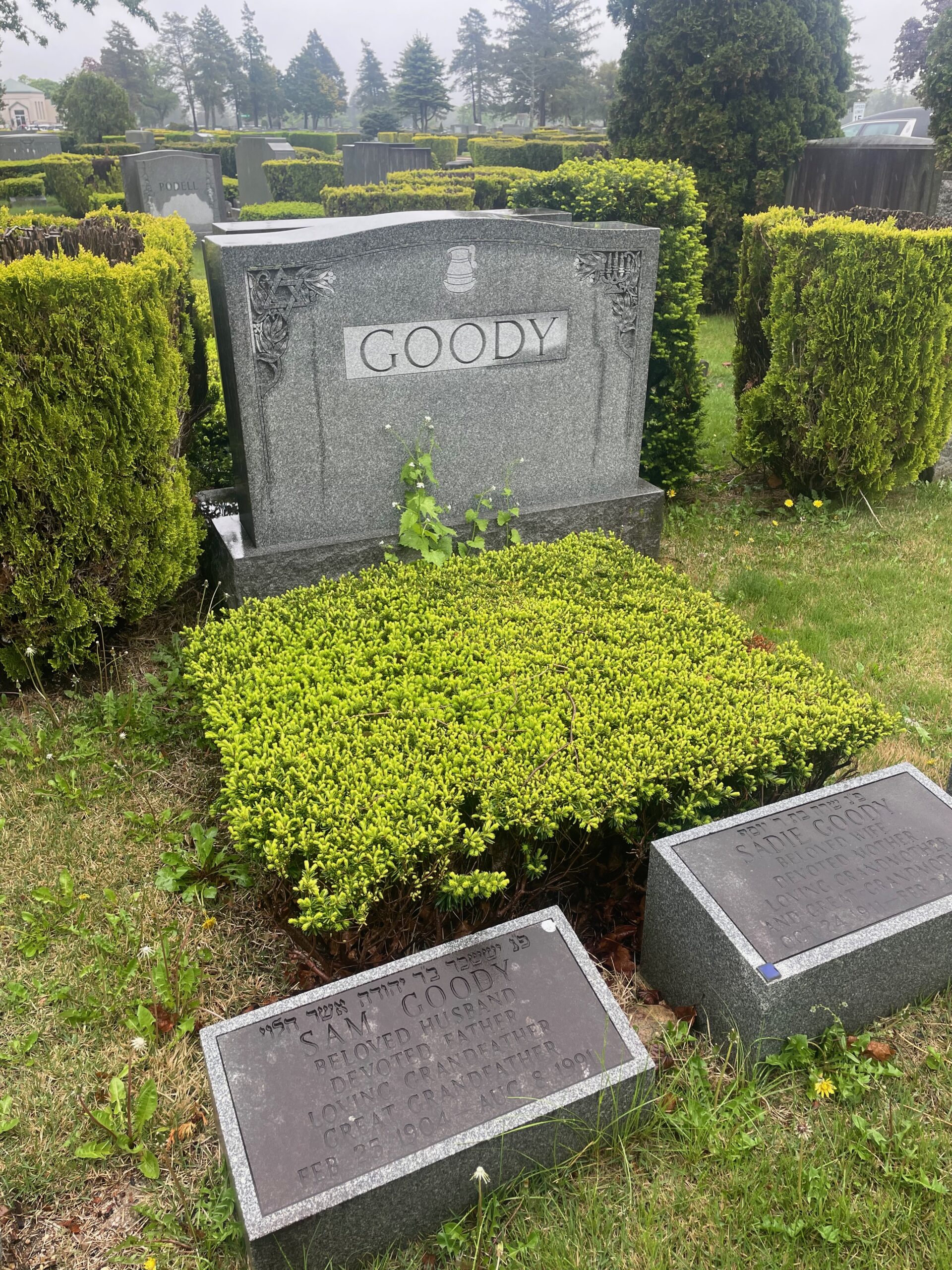
Born in 1904 in New York City, Sam Gutowitz grew up in the city and started running stores, part of the Jewish merchant class. His father was a tailor and his parents had migrated from Poland. A common enough trajectory. Gutowitz was a fine enough name for the Jewish community, but in the broader world, he didn’t want to be tainted with his heritage, so he went with Sam Goody. It really stuck too, as you can see from the grave. He didn’t even use Gutowitz on the tombstone, even though it’s a Jewish cemetery with Hebrew on the grave.
Well, Goody did one thing in American history that matters. In the 1940s, he opened a record store, right after the creation of long-playing records. He already had plenty of history running stores by this time. He worked in the discount world, where there was a lot of money if you were crafty and lucky enough to make it work. This happened because in 1938, when he was running a toy store. Someone came in asking if he had any records. He said no, but the customer then said that if he had any, he’d probably buy them. So he started scouring around basements and people’s sales and buying them and it turned out they sold. He bought 300 opera records from a family in Brooklyn for $60. He sold them for $1,100. This was good business.
Goody basically cornered the market on discounted LPs, for which there was a huge market among young music fans who didn’t have a lot of money. What this meant was something no one had experienced before–an enormous record store that had a huge amount of stock and variety. So if you were in the know, you could visit his store on 49th Street and be in what must have been complete paradise. It’s hard to imagine in this day of having every conceivable music available to you in some form or another how amazing this must have been.
As you can see from my Music Notes posts, I can listen to some old country and then some new post-punk album and then some jazz from any era and then an African album from the 70s and I can live this life of real musical enjoyment with enormous diversity. This hasn’t quite been my whole life, but the idea of a really broad range of music has been known since I was kid. I remember going to House of Records in Eugene when I was in college and just picking random things that sounded interesting. In fact, I took a lot of ribbing from my friends when I bought Muzsikas’ Maramoros: The Lost Jewish Music of Transylvania when in college, just because I wanted to hear what that sounded like. I still have that album too and while I don’t listen to the whole thing much, I do enjoy it when it comes up on shuffle. Well, it was Goody who created the world when such a thing was plausible.
Anyway, Goody’s discount record store model worked like gangbusters. He made money hand over fist here. When most stores sold a record for $3.98, he sold it for $3.25. Notably, he knew nothing about music and didn’t care. But he did hire people who did know about music for his store. In 1951, he created the chain of record stores in his name that you know him for. Later, Goody had money problem and creditors took over the chain in 1959, but he was associated with it to some degree for a long time. He was still around in 1978 when the American Can Company bought the chain and he made plenty of money on that sale. Why American Can? It was just a conglomerate by that point and had already purchased Musicland, which was the main rival to Goody’s discount empire, so it was the kind of logical consolidation at the heart of capitalism. Goody died in 1991, at the age of 87. It was heart failure.
It’s interesting that there’s so little on the man on the internet. The chain has a Wikipedia page, but he doesn’t. He did get a decent New York Times obit. But everyone of not one but about three generations at least knows who he is. No more though. There was talk that the last Sam Goody record store was going to close this year, though I am not 100% sure if that happened.
Sam Goody is buried in New Montefiore Cemetery, West Babylon, New York.
If you would like this series to visit other people who gave their names to the store chains they founded, you can donate to cover the required expenses here. Richard Warren Sears is in Chicago and so is Aaron Montgomery Ward. Same cemetery in fact. Previous posts in this series are archived here and here.
 Log in



 reply
reply