Type-A bureaucrat who professionally pushes papers in the Middle East. History nerd, linguistic geek, and devoted news junkie.
12377 stories
·
129 followers

Erik Visits an American Grave, Part 2,045

1 Comment and 2 Shares

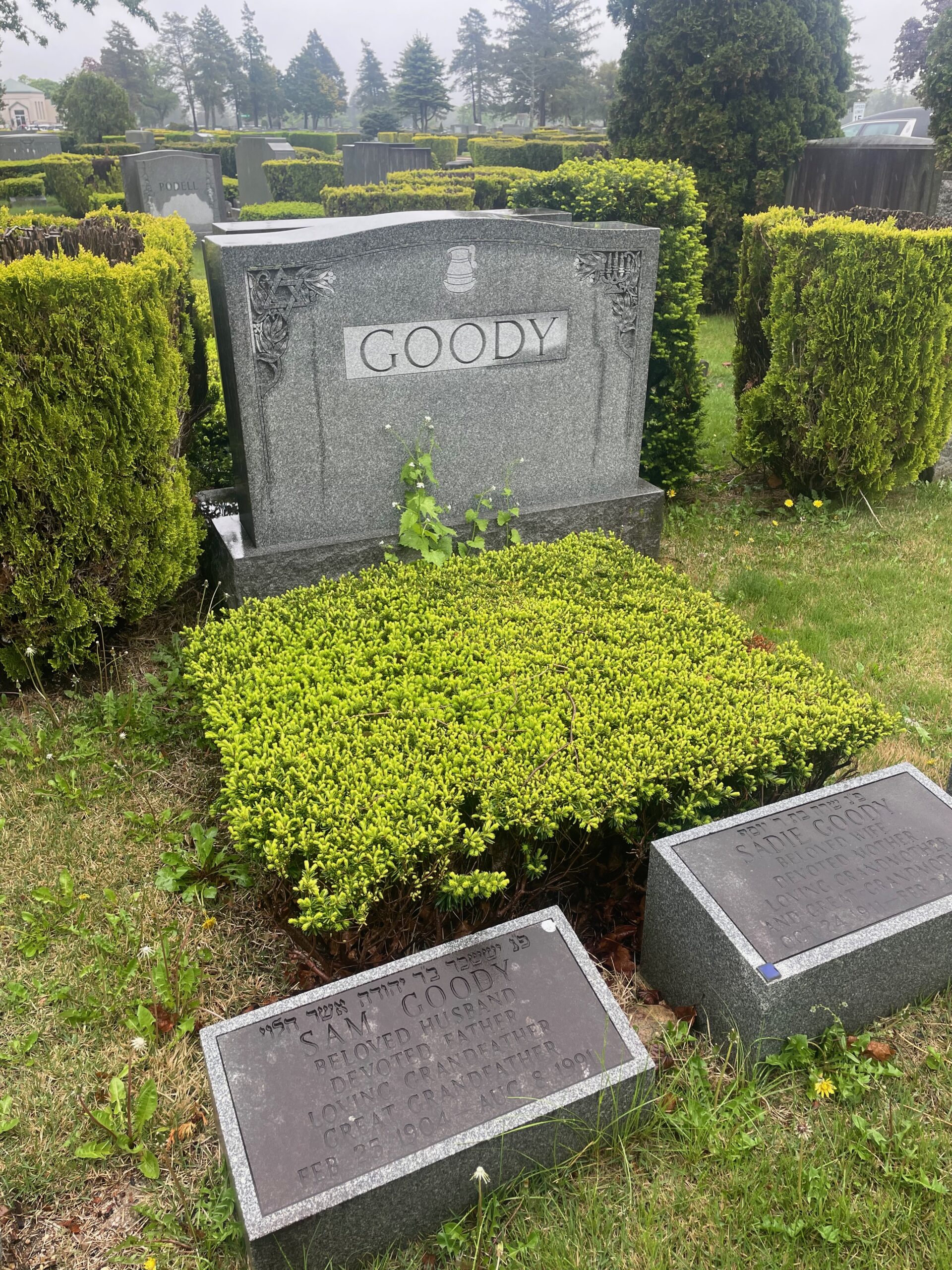
This is the grave of Sam Goody.

Born in 1904 in New York City, Sam Gutowitz grew up in the city and started running stores, part of the Jewish merchant class. His father was a tailor and his parents had migrated from Poland. A common enough trajectory. Gutowitz was a fine enough name for the Jewish community, but in the broader world, he didn’t want to be tainted with his heritage, so he went with Sam Goody. It really stuck too, as you can see from the grave. He didn’t even use Gutowitz on the tombstone, even though it’s a Jewish cemetery with Hebrew on the grave.

Well, Goody did one thing in American history that matters. In the 1940s, he opened a record store, right after the creation of long-playing records. He already had plenty of history running stores by this time. He worked in the discount world, where there was a lot of money if you were crafty and lucky enough to make it work. This happened because in 1938, when he was running a toy store. Someone came in asking if he had any records. He said no, but the customer then said that if he had any, he’d probably buy them. So he started scouring around basements and people’s sales and buying them and it turned out they sold. He bought 300 opera records from a family in Brooklyn for $60. He sold them for $1,100. This was good business.

Goody basically cornered the market on discounted LPs, for which there was a huge market among young music fans who didn’t have a lot of money. What this meant was something no one had experienced before–an enormous record store that had a huge amount of stock and variety. So if you were in the know, you could visit his store on 49th Street and be in what must have been complete paradise. It’s hard to imagine in this day of having every conceivable music available to you in some form or another how amazing this must have been.

As you can see from my Music Notes posts, I can listen to some old country and then some new post-punk album and then some jazz from any era and then an African album from the 70s and I can live this life of real musical enjoyment with enormous diversity. This hasn’t quite been my whole life, but the idea of a really broad range of music has been known since I was kid. I remember going to House of Records in Eugene when I was in college and just picking random things that sounded interesting. In fact, I took a lot of ribbing from my friends when I bought Muzsikas’ Maramoros: The Lost Jewish Music of Transylvania when in college, just because I wanted to hear what that sounded like. I still have that album too and while I don’t listen to the whole thing much, I do enjoy it when it comes up on shuffle. Well, it was Goody who created the world when such a thing was plausible.

Anyway, Goody’s discount record store model worked like gangbusters. He made money hand over fist here. When most stores sold a record for $3.98, he sold it for $3.25. Notably, he knew nothing about music and didn’t care. But he did hire people who did know about music for his store. In 1951, he created the chain of record stores in his name that you know him for. Later, Goody had money problem and creditors took over the chain in 1959, but he was associated with it to some degree for a long time. He was still around in 1978 when the American Can Company bought the chain and he made plenty of money on that sale. Why American Can? It was just a conglomerate by that point and had already purchased Musicland, which was the main rival to Goody’s discount empire, so it was the kind of logical consolidation at the heart of capitalism. Goody died in 1991, at the age of 87. It was heart failure.

It’s interesting that there’s so little on the man on the internet. The chain has a Wikipedia page, but he doesn’t. He did get a decent New York Times obit. But everyone of not one but about three generations at least knows who he is. No more though. There was talk that the last Sam Goody record store was going to close this year, though I am not 100% sure if that happened.

Sam Goody is buried in New Montefiore Cemetery, West Babylon, New York.

If you would like this series to visit other people who gave their names to the store chains they founded, you can donate to cover the required expenses here. Richard Warren Sears is in Chicago and so is Aaron Montgomery Ward. Same cemetery in fact. Previous posts in this series are archived here and here.

The post Erik Visits an American Grave, Part 2,045 appeared first on Lawyers, Guns & Money.

Read the whole story
fxer
40 minutes ago
reply
Mall fixture Sam Goody, across from Orange Julius and Claire’s
Bend, Oregon
hannahdraper
1 hour ago
reply
Washington, DC
Share this story
Delete

“World Heritage” — The Real Story of Belgian Beer Culture’s UNESCO Recognition

1 Share

How did Belgium become the only country to have its beer culture recognised by UNESCO as part of the intangible culture of humanity?

The post “World Heritage” — The Real Story of Belgian Beer Culture’s UNESCO Recognition appeared first on Belgian Smaak.

Read the whole story
hannahdraper
16 hours ago
reply
Washington, DC
Share this story
Delete

Mosul Eye Announces Book Release: Documenting Our History

1 Comment

As the year draws to a close, I would like to extend my warmest wishes to everyone, across all traditions and celebrations, for a peaceful end of the year and a hopeful New Year ahead.

For many years, Mosul Eye was written under the pressure of urgency — to document, to bear witness, and to ensure that what was happening in Mosul under ISIS rule would not disappear into silence. During that time, there was little space to step back and tell the full story behind the reporting itself.

I am grateful to finally share that I have now found the time and distance needed to write that story.

In the coming year, my book, Mosul Eye, will be published, telling the full account of how the project began, what it meant to document life under occupation, and how history, memory, and resistance intersected during one of the darkest periods of Mosul’s modern history.

The book will be released next year, and it is now available for pre-order.

👉 You can pre-order the book here:
https://www.skyhorsepublishing.com/9781510785670/mosul-eye/

Thank you, as always, for reading, supporting, and believing in the importance of truth, memory, and historical record.

Wishing you all peace, health, and hope in the year ahead.

— Omar

Read the whole story
hannahdraper
16 hours ago
reply
This man is one of the bravest people alive today.
Washington, DC
Share this story
Delete

Saturday Morning Breakfast Cereal - Butterfly

2 Shares


Click here to go see the bonus panel!

Hovertext:
It may not be the explanation, but it is an explanation.


Today's News:
Read the whole story
hannahdraper
22 hours ago
reply
Washington, DC
Share this story
Delete

Why I really left the Post

1 Share

Why I really left The Post

The tepid tell-all behind the headlines

Screenshot of the top of my last column. Headline reads “Work Advice: Karla’s final performance review, part 2.” Photo underneath shows a white woman’s hands typing on a keyboard, with a computer mouse and a pair of glasses sitting to the side.
Stock photo. You think I’ve ever had a desk that clean? Lol, as the kids say.

One pro tip I left out of my final Work Advice column: When leaving a job, your farewell message is a space for gratitude, not grievances. Stick to whatever positive things you can say with a straight face.

People who know your story, know your story. Those who don’t know can deduce—from the brevity of your message, the names you omit, the suddenness of your departure, the timestamp on your email — what the real story is.

Yes, you should tell the unvarnished truth if you were driven out by office politics, toxic management, harassment, corruption, or other nefarious forces. But the time for that truth-telling is in your exit interview with HR, or in testimony before a judge or Congress. Spilling the whole ugly story in your farewell letter leaves bystanders wondering if perhaps you were let go for valid reasons. It’s not just protocol; it’s protecting yourself.

Of course, if you play it too coy on the heels of a series of high-profile resignations and firings and cutting-to-the-bone layoffs, people inevitably think you’re hiding something.

Screenshot of responses from Post readers and commenters speculating about the reasons my column ended.
One does not simply bid a casual farewell to Mordor.

So here’s my real story, devoid of diplomacy, untouched by editors other than me:

I’m tired, and the Post is broke.

As I said in my farewell, I’ve been writing this column on top of doing a day job and being a parent for fourteen years. The nice thing about having multiple jobs is that they often balance out. Mulling over a juicy column topic often distracted me from a long, overwhelming week at the day job. Or I’d write a clunker of a column, but receive kudos for completing a challenging work project. And of course, the high-wire juggling act of childrearing was always there to keep me humble. It was a self-sustaining perpetual-motivation arrangement.

Quitting was not a decision I came to lightly. I don’t end things (books, films, jobs, relationships) as long as I think there’s any chance at redemption and renewal. I’ve hit plenty of walls over the years in this gig. Time and again I’d be burned out, ready to sign off. Then I’d get a beautiful brain-teaser of a letter that refueled my imagination and opened up new conversations. But in the latter half of this year, I was just tapped out, and my well wasn’t being replenished.

This year in particular, my columns have felt like whistling past a graveyard with an enormous tire fire blazing in the middle of it. Spats over office noise and cleavage felt increasingly like a distraction from federal workers being jerked like yo-yos, male white supremacist appointees trying to ensure no one besides them benefits from affirmative action, massive layoffs lighting up LinkedIn with “Open to Work” banners, and immigrant workers being literally snatched from their jobs by masked government thugs. The solutions to those issues take more than 800–1000 words a week from a smart-aleck in a side gig.

This year in particular, my columns have felt like whistling past a graveyard with an enormous tire fire blazing in the middle of it. … The solutions to those issues take more than 800–1000 words a week from a smart-aleck in a side gig.

So, the Monday before Thanksgiving, I sat at my keyboard pecking out a formal announcement to my editor that I would not be renewing my contract at the end of the month.

Mid-email, I got a call from someone further up the Post management chain. He apologetically informed me that, as a result of subscription losses and ongoing budget woes, the Post was cutting freelance columnists. He assured me that the decision had nothing to do with my work — it was strictly business.

I have no reason to think otherwise. In fact, I’d long suspected the Post’s cost-to-benefit ratio of running my little column might be edging toward the red. If letting me go means they can keep a hardworking reporter or copyeditor on staff, that’s fair.

So it was a mutual parting, independently decided, although I’m counting it as a voluntary departure for my ego’s sake.

Maybe it should be more dramatic or noble — a tale of speaking truth to power. For that, we have far more consequential departures by Post talent: Ann Telnaes. Jen Rubin. Karen Attiah. Gene Robinson. Ruth Marcus. Jonathan Capehart. David Shipley.

Don’t get me wrong; I’m distraught over the editorial changes at the Post and the taste its leadership seems to have developed for boot leather. I just can’t claim that as the primary impetus for my departure.

Don’t get me wrong; I’m distraught over the editorial changes at the Post and the taste its leadership seems to have developed for boot leather. (I wrote about it here.) I just can’t claim that as the primary impetus for my departure, having sat so long with that discomfort. And I will always be proud of having had the chance to write under their masthead. For now, I can still say that with no asterisk.

As for what’s next: I genuinely have no idea. Sleep, mostly, and a holiday break from the day job where I don’t have to think about paid work at all. After that, I’ll see what other interests and amusements creep into my newly freed-up brain space.

But first, a nap.

Photo of me reclining on a sofa with a tortoiseshell cat snuggled across my chest and a laptop on my lap. Cat and I are both looking at camera.
All that is best in life, minus coffee. And the kids, of course. Can’t forget the kids.
Read the whole story
hannahdraper
3 days ago
reply
Washington, DC
Share this story
Delete

Funny Numbers

2 Comments and 9 Shares
In 1899, people were walking around shouting '23' at each other and laughing, and confused reporters were writing articles trying to figure out what it meant.
Read the whole story
hannahdraper
3 days ago
reply
Washington, DC
popular
4 days ago
reply
Share this story
Delete
2 public comments
deebee
3 days ago
reply
At first I thought (Skidoo) there so we know he’s not referencing the Jim Carrey movie.
America City, America
alt_text_bot
4 days ago
reply
In 1899, people were walking around shouting '23' at each other and laughing, and confused reporters were writing articles trying to figure out what it meant.
Next Page of Stories