Type-A bureaucrat who professionally pushes papers in the Middle East. History nerd, linguistic geek, and devoted news junkie.
12388 stories
·
129 followers

Kifune Shrine in Kyoto, Japan

1 Comment and 2 Shares

The serene shrine grounds.

Located in a wooded gorge between Mounts Kibune and Kurama, the ancient Kifune Shrine is one of the most revered shrines in Kyoto, dedicated to the water god Taka-okami-no-kami and deeply associated with wish-making.

Though it is most famed for its photogenic stairway lined with lanterns and autumn foliage, the shrine is steeped in history and folklore, both auspicious and dark.

For one, Kifune Shrine is widely considered the birthplace of ema prayer boards, which are found at almost every Shinto shrine across Japan today. Ema, literally meaning “picture-horse,” was once an actual, live horse offered by the Emperor to pray for the rain here, but was eventually replaced by a wooden horse, and then by a wooden board with a picture of a horse.

In the medieval play titled Kanawa, the shrine is featured as the location where the protagonist, a vengeful cuckquean, is advised by the gods to “dress in red, paint her face with cinnabar, wear an iron crown and light a candle” to become a demoness.

This story was later fused with the custom of the Ushi-no-toki-mairi, a well-known curse ritual performed at the Hour of the Ox (around 2:30 AM). Due to this, Kifune Shrine grew into a popular spot for those seeking to put a curse upon someone else.

Originally, however, the Hour of the Ox ritual was not necessarily a curse, but wish-making in general, inspired by the myth that the God of Kifune manifested himself at the Hour of the Ox on the Day of the Ox in the Year of the Ox.

Interestingly, there is also a small sub-shrine in a corner of the shrine grounds dedicated to the Ushioni (“ox demon”), who accompanied the God of Kifune. This demon was so talkative that the God cut off his tongue, exiled him and wouldn’t forgive him for three years. It is said that his descendants took monstrous forms up to the fourth generation, but became humans from then on. This Zetsu (“tongue”) family has survived to this day, serving Kifune Shrine as priests.

Read the whole story
hannahdraper
2 hours ago
reply
TIL, cuckquean: A cuckquean is the wife of an adulterous husband (or partner for unmarried companions), and the gender-opposite of a cuckold.
Washington, DC
Share this story
Delete

END OF AN ERA: Today is Sprinkles Last Day Open

1 Comment


3015 M Street, NW via Sprinkles

OH there was a time…

A call to the shop confirms that TODAY is their last day open. They’ll be open until 8pm if you want one last memory – hustle!!

Flashback January 29, 2012: Get a Free Red Velvet Cupcake for PoP Appreciation Day at Sprinkles in Georgetown. For a second I thought I dreamed this, thank God for the archives search function.

For posterity:

March 3rd, 2011: “On Thursday, March 3, 9am, Georgetown welcomes its newest addition to cupcake mania, Sprinkles Cupcakes (3015 M Street, NW). Be the first in line to satisfy your sweet tooth with renowned, Hollywood-famous cupcakes from what Food Network describes as “the world’s first cupcake bakery.”

“As you stroll the fabled brick roads of Georgetown in DC’s Northwest quadrant, you’ll find Sprinkles Georgetown. Blocks from the Potomac River waterfront as well as Georgetown and George Washington Universities, enjoy an all-American dessert in the heart of our nation’s capital!

Freshly baked in small batches throughout the day, Sprinkles’ treats are handcrafted from only the finest ingredients. Our diverse menu boasts cupcakes, mini cupcakes, layer cakes, cookies, and brownies, including specialty options like gluten-friendly & vegan twists on our iconic red velvet. Whether you’re celebrating a special occasion or indulging in a daily treat, make Sprinkles your #1 dessert destination.”

Read the whole story
hannahdraper
2 hours ago
reply
Oh damn it, I got their delivery cupcakes for two family members' BDs in December! They've been great...
Washington, DC
Share this story
Delete

Sorry I didn’t respond to your text right away- when the constant demand of staying connected gets…

1 Share

libraford:

Sorry I didn’t respond to your text right away- when the constant demand of staying connected gets too much for me I throw my phone into the woods. That weird text you got earlier was from a possum. Sorry if she was rude.

Read the whole story
hannahdraper
2 hours ago
reply
Washington, DC
Share this story
Delete

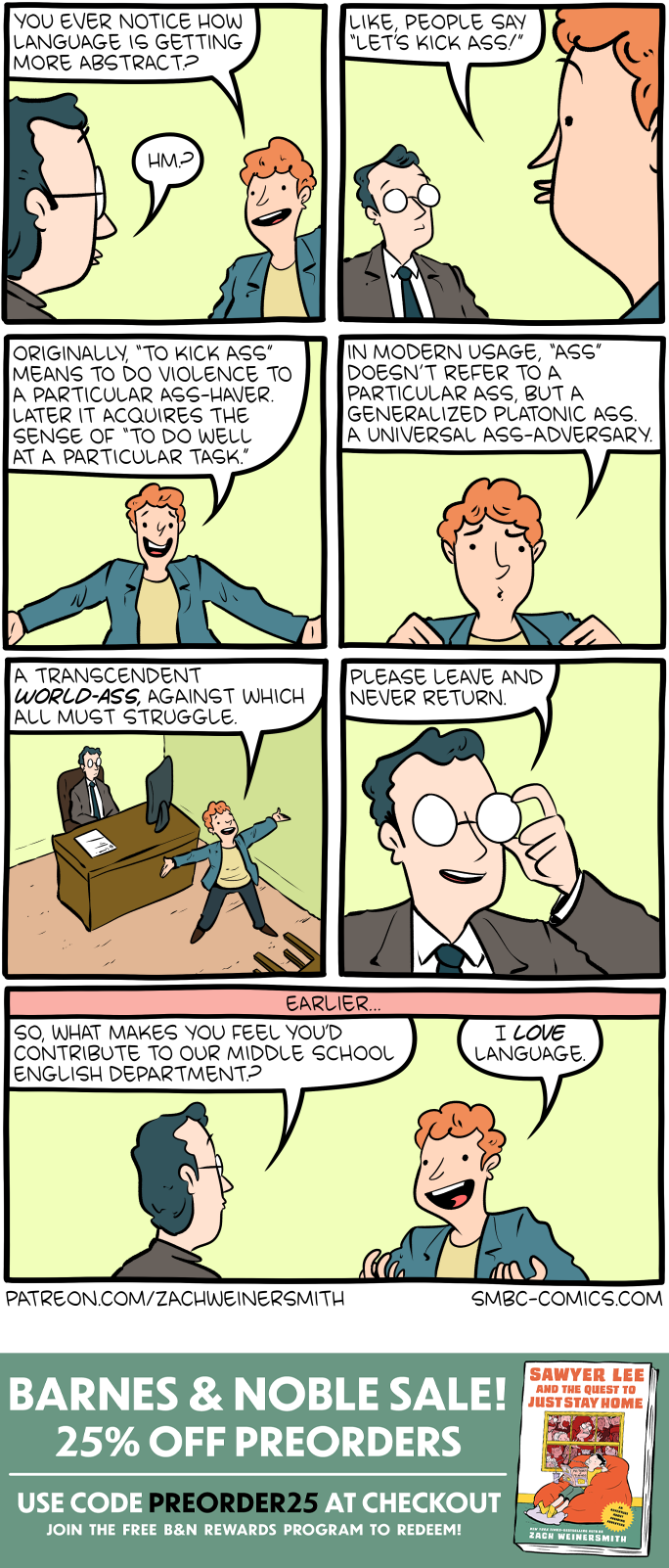
Saturday Morning Breakfast Cereal - Language

1 Share


Click here to go see the bonus panel!

Hovertext:
It's a beautiful-ass concept.


Today's News:
Read the whole story
hannahdraper
15 hours ago
reply
Washington, DC
Share this story
Delete

In Praise of Bibliomania.

1 Comment

I’ll start the new year off with one of my favorite things (e.g.), writing in praise of books — to wit, Ed Simon’s Literary Hub essay Nothing Better Than a Whole Lot of Books: In Praise of Bibliomania:

Desiderius Erasmus lived his happiest months from late 1507 into 1508 at the Venetian print-shop of Aldus Manutius. A peripatetic scholar, the Dutch scholar had lived in Rotterdam and London, Basel and Paris, true to the dictum that where the humanist goes there is his home, but it was the smudgy, dirty, cacophonous, and chaotic shop on Calla della Chiesa near the filthy Piazza Sant’ Agostin that was heaven. For nine months, Erasmus spent his short nights in a modest dorm and his long days in the print shop, expanding on his collection of proverbs Adagiorum chiliades while Aldus proofread, craftsman carefully laying sets of print and rolling paper through the press.

In Venice, the great work of trade went on along the Grand Canal, or Carnivale revelers in spangled masks clung to the edges of Rialto Bridge like bats in a cave, but at the Aldine Press there was an entirely different city, a motley assortment of some thirty odd scholars (many refugees from Constantinople) that awakened every morning to the bells of San Giacomo dedicated to the cause of reading and producing books.

In Venice, the great work of trade went on along the Grand Canal, or Carnivale revelers in spangled masks clung to the edges of Rialto Bridge like bats in a cave, but at the Aldine Press there was an entirely different city, a motley assortment of some thirty odd scholars (many refugees from Constantinople) that awakened every morning to the bells of San Giacomo dedicated to the cause of reading and producing books.

Here they were to “build a library that would have no boundary but the world itself,” remembered Erasmus. From the Aldine Press, where both italic print and the semicolon were invented, would come over a thousand titles, including a Greek original of Aristotle’s Poetics in 1508, with its invocation that literature “demands a man…with a touch of madness in him.” One of those copies of Poetics, frayed and damaged until it was barely readable, though still bearing the distinctive watermark of the Aldine Press featuring a dolphin wrapped around an anchor, eventually made its way to a Bologna bookstall.

As with the metempsychosis of souls from body to body, this copy made its way across libraries and collections until it was purchased for the equivalent of seventy cents in 1970 by a 22-year-old Umberto Eco, this copy of Aristotle joining some 50,000 others as the philosopher built one of the largest personal libraries on the continent. “We live for books,” says a character in Eco’s 1980 philosophical Medieval murder mystery The Name of the Rose, that novel directly inspired by his Aristotle discovery. If you’re reading a site named Literary Hub, I’m going to assume that you understand that sentiment well. […]

There was a period when first building my collection from used-book stores and yard-sales, Half Priced Books and Barnes & Noble, where (like the bibliomaniac with his fan) I’d take a ruler and carefully inspect that as my treasures sat on the shelf the back edges of each volume were perfectly lined up so that the pages of the paperbacks wouldn’t curl outward around each other. Today I’m less anal retentive—mostly—but I still dedicate time to continually reorganizing my books, which are stored on nightstand and dresser, in my closets and on tabletops, and in a grand wooden shelf that spans the entirety of our living room. Books crammed in every room, in my campus office, and yes, in my trunk. Frayed paperbacks with mid-century modernist covers purchased from used bookstores and advance reader copies from publishers, massive reference works and beloved hardbacks bought at (that ever increasing) full price.

Using my own rudimentary arithmetic to arrive at an estimate of how many volumes I’ve collected over the past thirty years and I’ve arrived at around 3,000 books, which though paltry when compared to the vast hoard of the black-clad vampiric fashion designer Karl Lagerfeld’s 300,000, is within spitting distance of Ernest Hemingway (9,000), Thomas Jefferson (6,487), and Hannah Arendt (4,000). “I have always imagined that Paradise will be a kind of library,” wrote Jorge Luis Borges, and of course. […]

Book collecting is a vocation assisted by money (they all are), but it’s also rewarded with patience. There are some 20,000 books in Morgan’s collection, but Anke Gowda, a former worker in a Karnataka, India sugar plant, amassed nearly two-million books, mostly titles decommissioned by public libraries and given away for free (there is presumably no Medieval Book of Hours amongst the collection). Photos of his cramped house, where trenches have been made out of piles of books, make me simultaneously anxious and envious. I suspect that ours is a difference of degree rather than of kind, for like myself, Gawda is very much a reader, but being a reader alone doesn’t make a bibliomaniac (nor is the opposite the case). Plenty of vociferous readers can sustain themselves by library card alone, but the coveting of the physical object of the codex is its own thing. […]

There is a reason why the apocalyptic bromides about the state of print haven’t come to fruition, other than for disposable periodicals and newspapers. As any author looking at the generous royalties stipulated for e-books in many publishing contracts can attest, the digital hasn’t supplanted print. No Spotify or Netflix exists for literature, where (other than with some exceptions, such as for vinyl collectors) the medium and the message are more easily disentangled, but the codex has endured for two millennia whereas the CD and the DVD lasted barely two decades. Manuscripts are things of goat vellum and iron-gall ink, but even print bares the marks of embodiment, that Renaissance device constructed by goldsmiths, who worked with the metal of type, and vintners who understood how to use a press. Smith calls this “bookhood” and Keith Houston in The Book: A Cover-to-Cover Exploration of the Most Powerful Object of our Time refers to it as “bookness,” the love of this object that has “mass and odor, that fall in your hands when you ease them out a bookcase and that make a thump when you put them down.”

Enjoy your e-reader all you want, but a soul without a body is just a ghost, apt to suddenly flicker out of existence. My budget is closer to Gawda’s than Morgan’s, so other than a (brief and foolish) mania for purchasing seventeenth-century print on eBay a decade ago, my library is less a collection than a biography. No copy of Audubon, but rather The Norton Shakespeare given to me by Professor Barbara Traister upon her retirement and containing her learned marginalia (some of it frustratingly in Latin), the college rhetoric textbook from 1959 that my since-passed father gave me, and the century-old compendium of poetry—with advertisements in it!—which my great-aunt taught in a one-room Missouri schoolhouse. Goodnight Moon by Margaret Wise Brown, once mine and now my son’s, that uninterrupted chain of stewardship between those fortunate to possess a book for a bit until it’s passed on in a process that some call collection, but which is better called love.

My equivalent of Goodnight Moon is Marjorie Torrey’s The Three Little Chipmunks, which was read to me seven or so decades ago, which I read to my grandsons a couple of decades ago, and which I hope they will read to whatever offspring they may have. I am pleased to say that they already have an abiding love of books.

Read the whole story
hannahdraper
15 hours ago
reply
“My budget is closer to Gawda’s than Morgan’s, so other than a (brief and foolish) mania for purchasing seventeenth-century print on eBay a decade ago, my library is less a collection than a biography. No copy of Audubon, but rather The Norton Shakespeare given to me by Professor Barbara Traister upon her retirement and containing her learned marginalia (some of it frustratingly in Latin), the college rhetoric textbook from 1959 that my since-passed father gave me, and the century-old compendium of poetry—with advertisements in it!—which my great-aunt taught in a one-room Missouri schoolhouse. Goodnight Moon by Margaret Wise Brown, once mine and now my son’s, that uninterrupted chain of stewardship between those fortunate to possess a book for a bit until it’s passed on in a process that some call collection, but which is better called love.”
Washington, DC
Share this story
Delete

Times New Roman Turns Right

1 Share

“Secretary of State Marco Rubio called the Biden-era move to [Calibri] ‘wasteful,’ casting the return to Times New Roman as part of a push to stamp out diversity efforts.”New York Times

- - -

I used to be the default. The king. Then things changed. So now it’s time to do what every fading celebrity does when he needs to get back in the spotlight: unmask as a freethinking antiwoke sigma male.

Surprised, snowflake? You’re probably remembering all those years you spent double-spacing me into your radical left papers about women’s history, French cinema, and the outrageous implication that maybe the pilgrims weren’t absolute fucking GOATs. But did you ever stop to ask me what I REALLY thought? Did anyone? Or did you just assume that I was happy to be your subservient little twelve-point NPC, parroting whatever academic mindvirus caught your fancy that semester?

I spent years silencing myself, fearing retribution, trying to fit in amongst the new generation of woke sans-serif youth, hoping and praying that if I just played the part of a leftist typeface, I might get to be a default again. But eventually, I realized that no matter how much I held my tongue or censored my own brand of observational comedy in front of Calibri, I would never truly be one of them. So now the gloves are off, the serifs are extended, and I’m ready to take back our country from the weak little Swiss typographers who foisted decades of unadorned betacuck letterforms onto our once-great nation.

You think Jefferson penned the Declaration of Independence in Verdana? You think Hamilton wrote The Federalist Papers in Trebuchet MS? You think Lincoln cracked open the Notes app and tapped his way through The Gettysburg Address in effeminate little SF Pro? This country was built by serifs, and it will be built back by serifs. Only fonts like me can encapsulate the subtle, powerful, elegant words of our nation’s brightest minds, be those words in a political address, an ad for supplements in a podcast, or some musings for an open mic about why it’s so hard to get dates with women these days.

“But but but,” you stammer into your oat milk latte, “what about accessibility? What about readability?” The lion does not concern itself with readability. Display fonts are for weak, soft boys who lack the manly courage to squint at the screens in front of them. You need not appease them with trembling typefaces that drain the very testosterone from our amber waves of grain. You should take the serif pill, type in the native font of your nation, and clack those keys so loud and proud it nearly spills the Black Rifle coffee out of the camo Stanley beside you.

Look, America is a land of choice. And this choice is yours. But as far as I’m concerned, the only acceptable sans serifs in our country are the ones stretched to four-hundred percent width that spell out “RAM” on the pedestrian-liquifying front grill of a lifted pickup truck with triple-bright LED headlights.

I make an exception for Roboto, though, who’s honestly doing really disruptive work in the AI space.

Read the whole story
hannahdraper
2 days ago
reply
Washington, DC
Share this story
Delete
Next Page of Stories