 Log in



|
Type-A bureaucrat who professionally pushes papers in the Middle East. History nerd, linguistic geek, and devoted news junkie.
|
Washington, DC


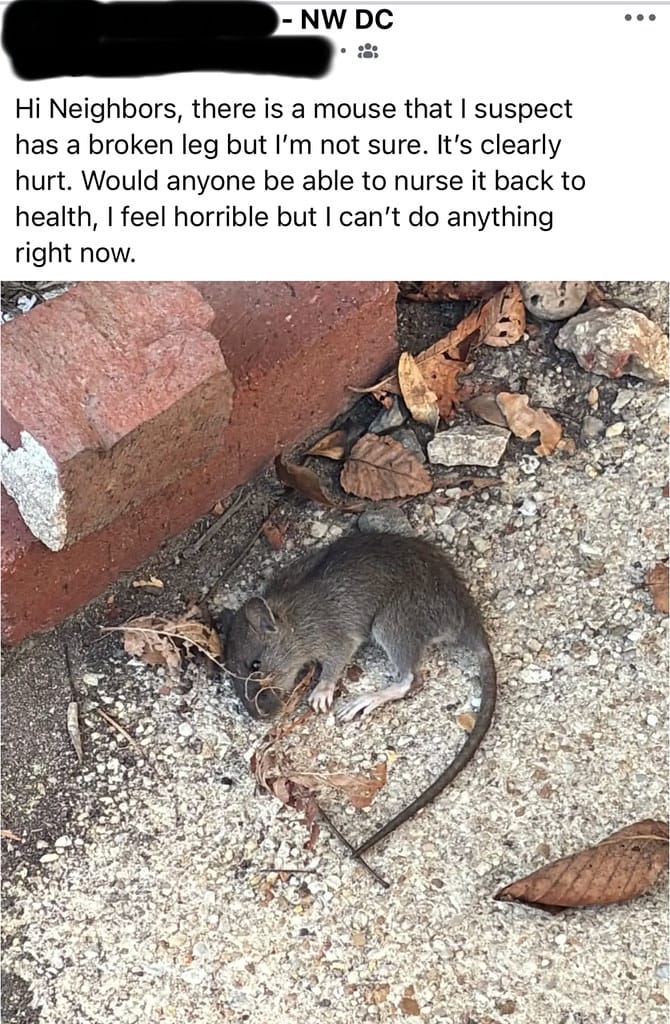
Ed. Note: Is that a mouse or a rat?
In the rodent justice system, the reality is represented by two separate, yet equally important groups: the Rodent and Vector Control Division, who seek to eradicate them, and the people with very big hearts, who seek to save all rodents. These are their stories.
dun-dun
Thanks to a few readers who passed on the above posting from a FB share group…: “I am not sure what to think.”
Oh, I am VERY sure what to think!!
Washington, DC



They could be made to accept the most flagrant violations of reality, because they never fully grasped the enormity of what was demanded of them, and were not sufficiently interested in public events to notice what was happening. By lack of understanding they remained sane. They simply swallowed everything, and what they swallowed did them no harm, because it left no residue behind, just as a grain of corn will pass undigested through the body of a bird.
Orwell, 1984
In a letter to his mistress Louise Colet, the novelist Gustave Flaubert remarked that “to be stupid, and selfish, and to have good health are the three requirements for happiness.” He then added, “though if stupidity is lacking, the others are useless.”
In all seriousness, a friend reminds me that, once all “this” is sort of over, one way of reconciling oneself to the fact that seventy-seven million people voted for Trump in 2024, after everything that had happened over the previous eight years, is that a very large percentage of those people are idiots, and consequently have never achieved the level of mens rea, as lawyers would say, to merit the consignment to a fiery pit that a more knowledgeable choice would require.
The post Glass half full appeared first on Lawyers, Guns & Money.
Washington, DC

Truth
Washington, DC

You’ve Always Been This Way is a column written by Taylor Harris, a late-diagnosed neurodivergent woman and 1980s preschool dropout, who identifies every moment from her past that filled her with shame, and mutters, “Yep, that tracks. I see it all now.”
- - -
Toni Morrison famously said, “If there’s a book you want to read, but it hasn’t been written yet, then you must write it.” Well, I wrote the book. And now, for the lady, perhaps a writing endeavor that does not cost three-fourths of her soul? Enter: A free online quiz—the first of its kind—to tell you if your neuros are normal or if they diverge.
It’s simple. Just circle every answer that resonates with you, and count the number you circled, out of sixty, at the end.
I’ve done the hard work for you, sifting through every memory and carefully selecting the most diverge-y ones. Remember to follow your gut and be creative. Maybe you didn’t perform Shakespeare in sixth grade, but did you audition for Dorothy and get the part of a yellow brick?
Maybe you’re not in perimenopause yet, but one time a rat bit your face, so same.
(Fine print: This is not medical advice, but I can guarantee 100 percent accuracy based on a sample size of one. Look for it in the DSM-6.)
If you grew up taking magazine quizzes on Friday nights in Stacey’s den—or alone, pretending you were scoring Stacey’s and Becky’s answers while they grabbed you a Diet Coke, when really they were across town prank calling your landline to order Schweddy balls—this is your chance to get back at them with deep knowledge… via an autism assessment.
Don’t think too long or hard; just select the responses that speak to you. But if they speak while chewing their food, you have every right to scream at them and leave the dinner table.
1. When separated from your primary caretakers as a baby, you…
A. Screamed until they returned from work or an outing.
B. Initiated full-scale shutdown of your bodily systems and required hospitalization for dehydration in the children’s hospital.
C. Found other human beings to be delightful and trustworthy.
2. When you auditioned for the role of Juliet in the sixth-grade Shakespeare production, the director said…
A. “I think we’ve found our first ethnic Juliet!”
B. “Your face is giving ghoul. Can you show the class how to be a witch for Macbeth?”
C. “You are curiously limber and can skip in a line. How about a court jester?”
3. When you tried out to be a tour guide at the University of Virginia, you…
A. Memorized all the historic information just in the nick of time.
B. Decided to bring props for a historical re-enactment at the Rotunda, including a plastic gun that pumped out balls.
C. Were shocked you didn’t make it past the first round.
4. When you tried out to be a summer orientation leader at the University of Virginia, you…
A. Thought you nailed it.
B. Answered the mock question about the quality of dining halls with, “You’ll probably want to order delivery from Yuan Ho.”
C. Were shocked you didn’t make it past the first round.
5. In first grade, when your buddy brought ranch dressing in her lunch, you…
A. Gagged in your shirt when she opened the lid.
B. Raised your hand and whispered your first public words to the teacher on duty: “Not all violence is physical in nature.”
C. Asked your mom to pick up some Hidden Valley from the store. Really, it’s the origin story of your love for condiments.
6. When introduced to Purity Culture in college, you thought…
A. Not only will I avoid doing the sex, but I will top it off with no tongue kissing or heavy petting!
B. Maybe Ginuwine was just talking about a carousel.
C. What if Jesus comes back before I level up to intercourse? Is there a rebate?
7. For high school senior superlatives, you were voted…
A. Most Likely to Succeed. Sorry, all votes are final.
B. Most Likely to Run for President. You ran so Obama could ball out.
C. Most Likely to Raise Your Kids in the Same Town so you could see everyone you knew every day.
8. When your first crush called and asked you to “go out” with him, you said…
A. “Yes, because I like the way you say ‘gila monster.’”
B. “No, but I like your bowl cut and the way you say ‘gila monster.’”
C. “My parents won’t let me, but can we still be friends?”
9. During your first winter break from college, all you wanted for Christmas was…
A. A cache of toys, including laser tag.
B. A particular pizza sub from a particular pizza shop, before they replaced the sesame seed bun for that doughy white garbage.
C. Time to catch up with high school friends.
10. When people asked what you wanted to be when you grew up, you…
A. Named any career your older siblings had mentioned.
B. Felt like Jonas in The Giver, knowing inside no “normal” job fit, and perhaps you’d been overlooked or condemned.
C. Said “undertaker” with a raised eyebrow and walked away.
11. When Colson Whitehead said in a public radio interview that, as a kid, he believed the Underground Railroad was a literal, underground track, you…
A. Thought, Bruh, where you from? Never say that out loud again.
B. Started singing “There’s a place for us” as you drove your minivan to the Lego store.
C. Added him to your neuro family tree, on the branch next to your godparents, Chris Rock and Daryl Hannah.
12. Within thirty seconds of meeting someone, you know, with 98 percent accuracy, if…
A. You don’t like them.
B. You want to marry them.
C. You don’t like them at all.
13. Perimenopause feels like…
A. Puberty, only with friends and funny tits.
B. Punishment for all that “heavy petting” and tongue kissing.
C. Ordering nachos with a blonde co-worker who says “chile con carrrrrne” and offers her Spanish name, “POW-LA,” without being asked.
14. When packing your hospital bag for the maternity ward, you included…
A. Nothing. You opted for a natural home birth. Breast is best, and it’s time for new bedsheets anyway.
B. A birth plan, laminated by your partner with real, live executive functioning.
C. A copy of The Immortal Life of Henrietta Lacks, in case labor went long.
15. The philosophy “experiences over things” is…
A. Garbage.
B. True, when the experience is a dark cave with books and an underground café run by Colson Whitehead.
C. Something you’ve felt deep in your bones and just needed influencers to put into words.
16. You most relate to the following fictional character…
A. Daria Morgendorffer.
B. Quinn Morgendorffer.
C. The squirrel with a snake bite from The Oregon Trail.
17. When you travel, you feel…
A. Fully alive to the world.
B. Homesick for about a day but slowly recalibrate.
C. Like Typhoid in The Oregon Trail.
18. Every morning you wake up thinking about…
A. Coffee.
B. The meaning of life.
C. How you’re gonna grab the bull by the horns.
19. If someone recommends a book or movie, you respond with…
A. “OMG, totally!” and put the title in your Notes app.
B. “OMG, totally!” and never think about it again.
C. “OMG, totally!” and sit on the recommendation until the appointed time, when the moon is a waxing gibbous, and the rooster crows six times to the tune of Sean Paul’s “Temperature.”
20. When something happens that you saw coming a mile away, you…
A. Stay quiet and humble. We all need grace.
B. Turn your back on the situation, like Jordan Lucas does on his opponents after a kill.
C. Stay mad because no one ever listens to you unless they think you can get them a book deal because you once had a book deal and now those publishing vultures in New York can’t find their own bestsellers and keep circling your intellectual block, so to speak, looking for good bones.
RESULTS
(By celebrity artist profile)
0-25 points: Justin Timberlake
Your neuros don’t diverge as much as we’d hoped, but you can still be popular and wear denim. Maybe you have nice teeth too. Want to talk about the weather on an elevator? Tell Jess and the kids we said hi.
26-40 points: RAYE
You’ve been called an old soul and are no stranger to anxiety and dark nights. You’re the kind of person everyone assumed was happy, and whether you have a formal diagnosis or not, you’re so full of empathy, spark, and genuine love that neurodivergents will ride with you forever.
41-60 points: SZA
You’ve been that girl. You’ve been telling people. You make art that sounds magnificently discordant on purpose and sells, but you’ll never exchange authenticity for numbers. Doing it your way is the only way worth doing it, and just because you’re quiet or quirky doesn’t mean you’re not clocking every person’s move. Oh, you wanna do a movie with Keke? You’ll nail that too. And keep your Doechiis close. They give you a chance to unmask and connect.
My score: 27
26-40 points: RAYE
You’ve been called an old soul and are no stranger to anxiety and dark nights. You’re the kind of person everyone assumed was happy, and whether you have a formal diagnosis or not, you’re so full of empathy, spark, and genuine love that neurodivergents will ride with you forever.
26-40 points: RAYE
You’ve been called an old soul and are no stranger to anxiety and dark nights. You’re the kind of person everyone assumed was happy, and whether you have a formal diagnosis or not, you’re so full of empathy, spark, and genuine love that neurodivergents will ride with you forever.
Washington, DC

How do I like a profile?
Please highlight what you like and add a query.
How do I dislike a profile?
Please use track changes.
What if I disliked a profile by accident?
Write “stet.”
Are you hiring freelancers?
No.
Can I end my “About me” section with a preposition?
Doing so will make you someone out with whom dates will not go.
What are some good date ideas for copy editors?
For clarity, we recommend MM/DD/YYYY.
What does the AP Stylebook say about sex on the first date?
Sex on the first date should not be capitalized, unless it comes as a huge surprise, in which case it should read as “SEX ON THE FIRST DATE??”
Do I need a hyphen in “sex-pest”?
You should not be using that word in your profile.
Are you hiring freelancers now?
We will never hire you.
How do I know if I contracted an STD?
STD is an initialism, not a contraction.
What if more people have been on dates than I have?
Rephrase?
Can I use British spellings?
It’s not our favourite.
I just wanted to offer my freelance services for a small fee.
That’s not a question.
Can you check my colon usage?
We’re not doctors.
How can I know if I got my date pregnant?
Proofread their messages carefully. Did they miss a period?
My date told me they’re disinterested. Should I assume they’re also uninterested?
You’re just showing off now.
Will I ever find love?
Yes. Our style guide is organized alphabetically, so “love” can be found between “louche” and “lowbrow.” Unfortunately, our algorithms indicate you will die alone.
How can I know if I got my date pregnant?
Proofread their messages carefully. Did they miss a period?
Proofread their messages carefully. Did they miss a period?
Washington, DC
Next Page of Stories