“An intense, public outcry over a woman’s account of being gang-raped at a Cornell University fraternity house prompted New York’s governor this week to angrily yank control of the investigation away from the local prosecutor who didn’t initially see what happened as a crime.” —A.P.
- - -
Dear Cornell University,
My son is six, so admittedly, we have some time. Still, college admissions have become terribly competitive, and it is never too early to start researching the institutions that might one day shape him. Cornell seemed like a good place to start.
My son is bright. He reads above grade level. He plays competitive chess and does competitive gymnastics. He is fascinated by science, numbers, and infinity. I am currently debating Mandarin lessons, because six is, I’m told, when one begins panicking about the Ivy League. Last week, he asked me whether numbers ever stop, and I told him no, which led to several follow-up questions I was not academically equipped to answer.
This is why we need institutions like yours.
I understand Cornell offers thousands of courses across nearly eighty undergraduate majors. Your students study astrophysics, biomedical engineering, philosophy, artificial intelligence, and something called Operations Research and Information Engineering, which I do not understand but assume is more complicated than calling 911.
And yet I can’t seem to find HUM 101: Calling for Help When Someone Is Being Hurt in your course catalog.
Maybe it’s graduate-level? My son has already completed some introductory coursework. At his elementary school, when another child gets hurt, students are expected to find an adult. Someone is hurt. You get help. That’s essentially the whole semester.
I was relieved to learn that some students were reportedly allowed to submit essays in hopes of mitigating their suspensions. My son is already writing complete sentences, so we appear to be on track.
I understand things get more intellectually demanding at an Ivy League university: What if you’re at a fraternity? What if your friends are involved? What if you find out through Snapchat? What if helping would make things socially awkward? My son has not yet encountered these advanced ethical problems.
He does know how to use a phone.
Which makes me wonder whether smartphones operate differently in Ithaca. Perhaps Cornell students receive special models in which the emergency-call feature has been replaced by Snapchat.
Seven former Cornell students are accused in a civil lawsuit of sexually assaulting another Cornell student who says she was incapacitated. Messages allegedly inviting other fraternity members upstairs were sent to a larger group chat during the alleged assault. Everyone is talking about the seven. I keep thinking about the others.
I don’t know what every person in that group saw, knew, or understood. But I am raising one of the others. The boy who might someday be in the room. Or down the hall. Or holding the phone. The boy who didn’t do it. The boy who could therefore spend the rest of his life explaining that he didn’t do anything.
I don’t merely want my son to learn how not to rape someone. I was hoping we could aim a little higher.
Perhaps BYST 101: Other People Are Still People When Your Friends Are Watching. Prerequisites: none.
And, for exceptional students, maybe LEAD 401: Being the First Man to Ruin the Vibe.
I would enroll my son in that one. I want him to ruin the vibe. I want him to be annoying. To be the guy everyone hates for five minutes because he said, “Stop.” To lose friends if necessary. It seems a modest definition of courage, but we can save ambition for graduate school.
Cornell does, after all, have a distinguished tradition of producing leaders: governors, members of Congress, CEOs, Nobel laureates, people entrusted with decisions affecting millions of lives. Perhaps leadership could begin with one. Before teaching young men how to run the world, teach them what to do when the world is one room, one woman, one terrible thing happening, and nobody wants to be the first man to ruin the evening.
My son is six.
When someone says stop, he stops. When he does something wrong, “But he did it too” remains an argument, certainly, but so far has not survived peer review. He’s still learning. Sometimes he doesn’t share. Sometimes he cheats at Uno. I had to explain that you cannot change the rules of chess because you are losing.
I am under no illusion that I have raised a good man. I haven’t raised a man at all. I have a little boy.
And one day, I may hand him to a university like Cornell. I may spend eighteen years teaching him that doing the right thing doesn’t stop being the right thing when it becomes inconvenient, then trust you with the rest of his education. Teach him physics. Literature. Engineering. Teach him whatever impossible thing he decides he wants to know. There are just a few things I’d prefer he not unlearn.
That “stop” is a complete sentence.
That silence isn’t permission.
That friendship isn’t immunity.
That being one of the good guys, on occasion, requires doing something.
And that everyone else doing nothing does not make doing nothing right.
Anyway, please send me whatever information you have about the program. We have twelve years before my son applies. He already knows most of the material. I’d just like him to graduate still knowing it.
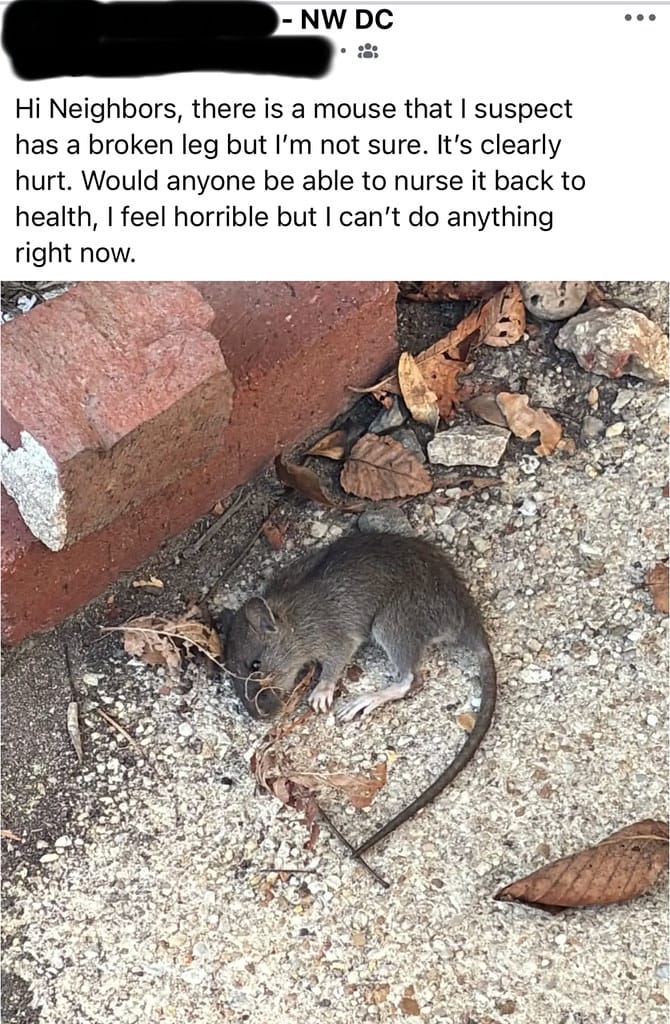
In the rodent justice system, the reality is represented by two separate, yet equally important groups: the Rodent and Vector Control Division, who seek to eradicate them, and the people with very big hearts, who seek to save all rodents. These are their stories.
dun-dun
Thanks to a few readers who passed on the above posting from a FB share group…: “I am not sure what to think.”
This has been an ugly year for rats in DC so my neighborhood, crunchy as it is, has very vocally moved onto team “kill them all”. The more ecologically-minded are thinking about foxes, snakes, and vultures but I think everyone's patience is exhausted.
 Log in