This is good. Not in the sense that it is good that these things are happening, but the successful resistance is definitely good:
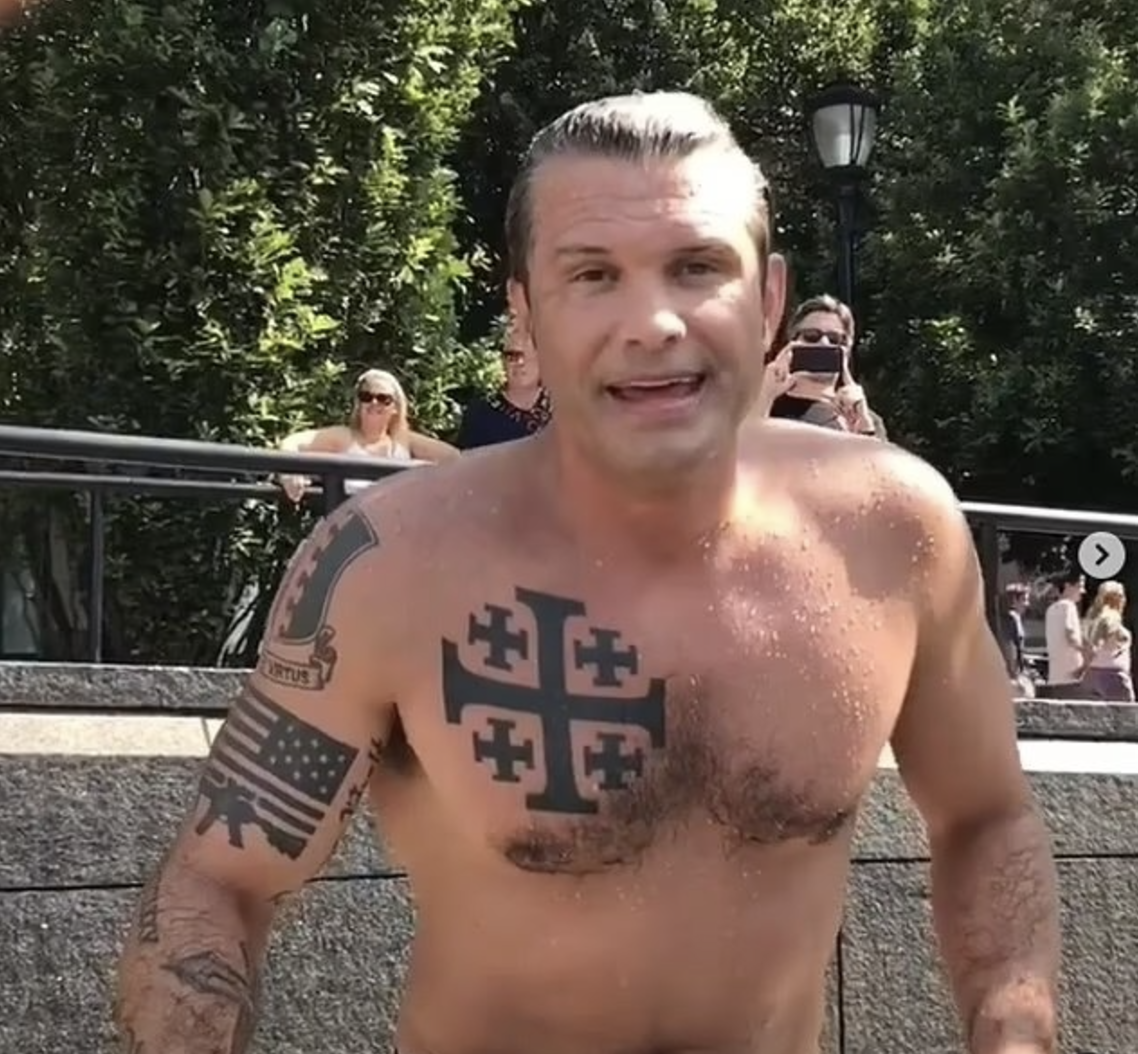
Defense Secretary Pete Hegseth used a slur to proudly announce to an auditorium of Marines in September that he was ridding the military of all transgender troops.
The Pentagon had set up review boards at bases around the globe, manned by everyday uniformed service members with narrow orders that all but ensured that the trans troops appearing before them would be voted out.
But just steps from the auditorium where Mr. Hegseth spoke, at Marine Corps Base Quantico, boards assigned to carry out those orders were doing the opposite. Instead of firing trans Marines, the boards were voting to keep them.
The same was happening in the Navy: Boards given strict rules instructing them to force out sailors were rebelling and voting to let them stay.
It is not just a few outlying individuals. Navy and Marine Corps boards have voted to retain trans members in nine of 12 cases.
A majority of Americans, 58%, continue to favor allowing openly transgender men and women to serve in the U.S. military, but support has declined from 71% in 2019 and 66% in 2021. The latest reading is from a Gallup poll conducted as President Donald Trump took two executive actions — one on his first day in office and another a week later — to reinstate a ban on openly transgender service members.
Every time a Democrat is asked “why do you favor allowing men to play women’s sports?” the answer should be “why do you favor throwing patriotic, loyal American out of the armed forces?” Republicans want to fight on the former question, and they’re terrified of the latter; there’s no reason we should yield to them the choice of battlefield.
> I’ll be on MS Now Saturday morning with Jacob Soboroff to talk about the Tommy of it all. Tune in at 10:35am ET to catch my segment!
> I was thrilled to be a guest on WNYC’s On the Media podcast where I talked about—you guessed it—Tommy, plus the themes in the piece below. Click here to listen!
> Welcome to the more than one thousand new subscribers to The Handbasket from over the last week. Thrilled to have you here and hope you’ll stick around.
Content warning: This story includes descriptions of sexual violence. Please take care while reading.
Donald J. Trump was found liable in 2023 for raping journalist and author E. Jean Carroll at a New York City department store in the mid-’90s. The following year, he was re-elected President of the United States. With that decision, Republicans voters made it clear: Sexual violence was no longer a red line.
In those cloudy weeks between Election Day 2024 and Trump’s January inauguration, I remarked online, “When I look at this incoming administration, all I see is rape.” It was in the people he was choosing for his cabinet; it was in the way he spoke to and about women; it was the way he bulldozed through any situation, regardless of consent. A decade on from the Access Hollywood tape, the culture Trump wrought has metastasized, with rape and rape culture influencing campaigns at all levels and lacing the current media landscape with landmines. Nowhere has that become more clear than Ohio’s gubernatorial race, where Trump-backed Republican Vivek Ramaswamy has thrown himself in the gutter in a bid to defeat Democrat Dr. Amy Acton by weaponizing the sexual assault she endured and survived as a child.
On Monday, October 12th, Ohio political blogger JD Byrnes wrote in his newsletter The Rooster that there were “rumblings” that “Ramaswamy's team plans to roll out an endorsement, such as it is, from Acton's estranged mother.” By early this week, an unaired ad began circulating online featuring Donna Arthur, Acton’s birth mother. Arthur lost custody to her children in 1978 after siding with Acton’s stepdad when the then-12-year-old alleged he’d raped her over the course of years. That context is conspicuously absent from the ad, with Ramaswamy giving Arthur space to slander Acton and urge people not to vote for her.
“She is a liar,” Arthur says in the ad. “She lies about her past. She says she grew up living in a tent. None of that is true. She’s lied her entire life.”
At first, Ramaswamy, who has consistently been polling behind Acton in recent weeks, was cagey about whether or not his campaign was behind the ad. Spokesperson Connie Luck wrote in a statement early this week: “We don't know what happened between Amy and her mother, who first spoke out about Amy in 2020, but we know that Amy Acton is a serial fabulist who has some serious problems with the truth that the public needs to be aware of before deciding who to entrust as governor.”
One glaring problem with Luck’s statement is that it’s simply not true that we don’t have a record of what Acton’s stepfather did to her. Conservative outlet The National Review found that court documents confirmed Acton’s account.
“While Donna Arthur was married to Cledith Arthur in 1978 when Acton was 12 years old, Cledith Arthur was charged with having sexual contact with her, documents show,” per the National Review story. “Evidence against him included a sworn statement from Acton’s biological father, and Acton herself was called to testify as a witness. Following his indictment by a grand jury, Cledith Arthur skipped town.”
By Tuesday evening, Ramaswamy had not only taken credit for the ad, but revealed he’d be putting a $4 million ad buy behind it.
Trump and Vice President JD Vance have remained steadfast in their support for Ramaswamy. Before a Ramaswamy campaign event on Wednesday, Vance told reporters that he was “a little bit disgusted when I see Republicans across the country who are whining more about that advertisement than they are about what the congressional Democrats and other Democrats want to do to the United States of America.”
Trump called it “a very powerful ad” in a post on Truth Social Friday morning, later saying “I know nothing about his stepfather,” in the midst of his jabbering outside the White House and seeming confused about whose stepfather to whom the reporter was even referring.
Trump wants us to believe that his support for Ramaswamy’s ad featuring Acton’s estranged mother has nothing to do with his support for it, when it’s obvious that he supports the ad because of it.
In a 2024 piece, I described what it was like being a working journalist the day the Access Hollywood tape dropped:
It’s late afternoon on Friday, October 7, 2016, and I’m at my desk in the newsroom, mentally heading towards the weekend. Election Day is one month away and I’m already exhausted by candidate Donald Trump’s relentless attacks on abortion rights, immigrants, any of his perceived enemies, and particularly his attacks on women. But, I think, soon it will be over. Soon Hillary Clinton will be president and Trump will be banished to stew on his golden toilet.
But then around 4pm, the Washington Post drops a story about an old Access Hollywood tape; one where Trump can be heard telling host Billy Bush, “I just start kissing them. It’s like a magnet. Just kiss. I don’t even wait…And when you’re a star, they let you do it. You can do anything. Whatever you want. Grab them by the pussy.”
By then I knew full well that Donald Trump hated women, but the tape laid bare the abject violence he was willing to perpetrate against any one he felt entitled to conquer. In fact, he had already been accused of this sort of violence by multiple women—but this time we got to hear it in his own words. I felt nauseous. Every cell in my body burned with rage. And then I got to work writing about it, because that’s what journalists do.
I’ve felt that burning rage many times over the past decade, but some instances stand out more than others. One was the day Susan Collins announced she’d be voting to confirm Brett Kavanaugh as a Supreme Court Justice; another was this past Monday when I watched the ad with Acton’s birth mother.
But Acton’s sexual abuse isn’t the first time the topic has come up this election cycle.
A Phoenix New Times exclusive published October 7th—incidentally, the 10-year anniversary of the Access Hollywood tape—detailed Arizona congressional candidate Bernadette Greene-Placentia’s rape in August. Speaking for the first time about the assault, Greene-Placentia said she was out in the very early morning hours fixing broken campaign signs around the district—something she had been doing to avoid the punishing Arizona summer sun—when “An attacker smashed her over the head. She blacked out. She woke up to find a strange man on top of her.” She said she waited weeks to share her story because she was embarrassed.
Greene-Placentia told the New Times that she believed the rape may have been politically motivated. “She heard him mumble something like, ‘-ic bitch, not a very good fuck,’ which her mind filled in as ‘Democratic bitch,’” according to the story. “She wasn’t sure that was exactly what he said.”
Her bravery in coming forward was immediately met with right-wing influencers “dissecting her story, alleging various discrepancies and accusing her of fabricating an allegation of rape for some kind of political gain,” per Talking Points Memo’s Christopher Mathias. In an episode of The Charlie Kirk Show the day after Greene-Placentia came forward, co-host Blake Neff read out loud online comments from viewers. “‘She either made it up or had the best night of her life,” Mathias reported. Another read by Neff said: “If she was too stupid to go to ER and do a rape kit, she’s too dumb to be in Congress.”
Greene-Placentia’s opponent, incumbent Republican Abe Hamadeh—who has publicly supported Andrew Tate, the manosphere influencer indicted on charges of trafficking minors, sex with a minor, and money laundering—condemned the allegations.
Also in Ohio, we have Republican Congressman Max Miller running for reelection, despite a litany of allegations against him. He and his ex-wife Emily Moreno—the daughter of Republican US Senator Bernie Moreno—have been and remain in a bitter custody battle over their young daughter, the details of which gained national attention thanks to a July story by Abby Vesoulis at Mother Jones that dove into the legal records.
Earlier this year, Moreno took their two-year-old daughter to the emergency room with a broken collar bone: Moreno did not know how the injury happened. An investigation by the Ohio County Division of Children and Family Services ensued, and records from mid-March, Vesoulis reported, “show that Moreno told detectives that Miller had previously thrown hot water at her, shoved her, and held a gun to her head; therefore, she couldn’t rule out that Miller caused their daughter’s fracture.”
Other allegations of violent behavior towards women have come out as a result of Moreno’s lawsuit against Miller.
Perhaps in a different time of place, the types of allegations would have led a candidate to drop out; or at the very least, led to some introspection and shame on the candidate’s part. But Miller has denied all accusations, remained in his race, and recently used the episode for a political ad. “Too many of us know the pain of divorce. It’s messy and complicated,” Miller says in the ad. “For two years, my family’s heartbreak has been dragged on to your TV because, well, that’s politics.” In a post along with the video, he makes the unfounded claim that “The allegations against me have been proven false time and again.”
In response to calls for Miller to resign in early August, this was Trump’s response: “It's a very sad thing. I know Max. He's a good person. I mean, I always thought he was a very good person, and I'm going to let the families figure that out.” Not a single top Republican elected official called for his resignation. It was yet another moment where the party made it clear that the abuse of women and children was not disqualifying.
Rape has been top of mind this fall in the wake of a lawsuit filed against Cornell University by a former student identified only as Jane Doe, alleging she drugged and gang raped by seven members of the Chi Phi fraternity at their house. After she reported the 2024 attack, the university did little to remedy the situation, forcing her to finish out the semester. Two of the seven men were expelled, but none ever faced criminal charges. The story has led to nationwide fury about the acceptance of rape into campus culture, and the little recourse that exists for victims.
In response to the heinous allegations made against the seven fraternity members, Trump said “I feel badly” for the men—not for Jane Doe.
This rich history of the GOP’s support for rape and abuse of women and children certainly set the stage for the Ramaswamy ad, but it didn’t make it any less appalling. Because while excusing these sorts of behaviors may be normal to true believers, none of this is normal. Ramaswamy’s attack on Acton was so egregious that even fellow Republicans who’d typically just No Comment their way out of it chose to say something—no matter how tepid.
“The ad, on its face, is deeply, deeply troubling,” Republican Mike DeWine, who Ramaswamy and Acton are running to replace, said on Thursday. “I would just urge the Ramaswamy campaign to take this down.”
Ohio Senator Jon Husted, who’s running for reelection in a tight race against former Ohio Senator Sherrod Brown, told reporters, “if it were me, I would not have run that ad." Ohio Secretary of State Frank LaRose, who’s also running for reelection, said “I probably wouldn't run an ad like that, but every candidate gets to make their own decision."
But beyond expressing disapproval over the exploitation of his opponents sexual abuse as a child, none of these Republicans have revoked their endorsements for Ramaswamy. DeWine confirmed to reporters that he still endorses “the whole ticket.”
The enormity of Ramaswamy’s choice to double down on the ad has already produced major responses.
MK Pritzker, wife of Illinois Governor JB Pritzker, announced a donation of $500k to Acton’s campaign in the wake of Ramaswamy’s ad. “Bad men gain power when we refuse to stand up and fight,” she wrote in a statement. “Vivek Ramaswamy represents everything that is wrong with our politics today: arrogance, cruelty, dishonesty, and the belief that it’s acceptable to say and do anything for power.”
Acton received the endorsement this week of the Columbus Dispatch Editorial Board, which called Ramaswamy’s ads against her “revolting and unsettling,” and writing that “sexual violence against children should not be politicized or taken as lightly as Ramaswamy appears to take it.” The Akron Beacon Journal and Chronicle Telegram Editorial Boards also endorsed Acton, citing Ramaswamy’s “below-the-belt personal hits.”
We won’t know the full impact of Ramaswamy’s ad until the polls close on November 3rd and every vote is counted. Donald Trump’s America has shown us that no conclusion is foregone, and victim-blaming sexual abuse victims may not be dealbreaker. With this attack, Ramaswamy has put rape back on the ballot. And it will be telling whether voters reject it or accept it.
 Log in